
Azerbaijan Technical University · Production
Machine Science Journal Platform
Open-access publishing platform for AzTU's Machine Science journal — manuscript submission, double-blind peer review, and DOI-registered articles.
Overview
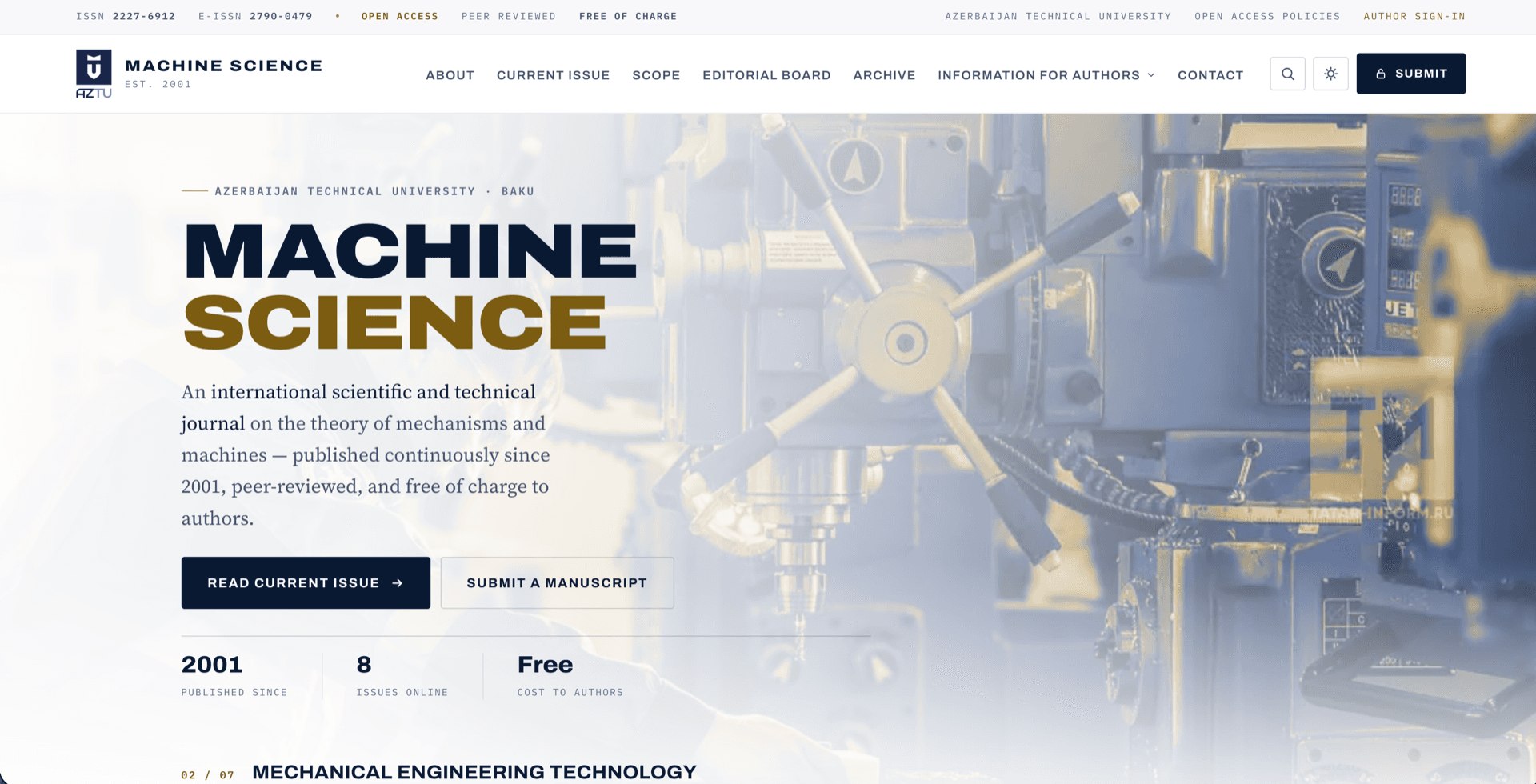
Machine Science is Azerbaijan Technical University's international scientific and technical journal, published continuously since 2001 (as Mechanics — Mechanical Engineering until 2011). I built the platform it now runs on: a public open-access journal site at msj.aztu.edu.az and the editorial back office behind it.
Researchers submit their manuscripts through the author portal instead of by email. Each submission enters an editorial pipeline where the editorial board routes it to subject-matter experts for double-blind peer review, collects reviewer decisions, and — once accepted — assigns the article to an issue, allocates page ranges, registers a DOI under the 10.61413 prefix, and publishes it open access.
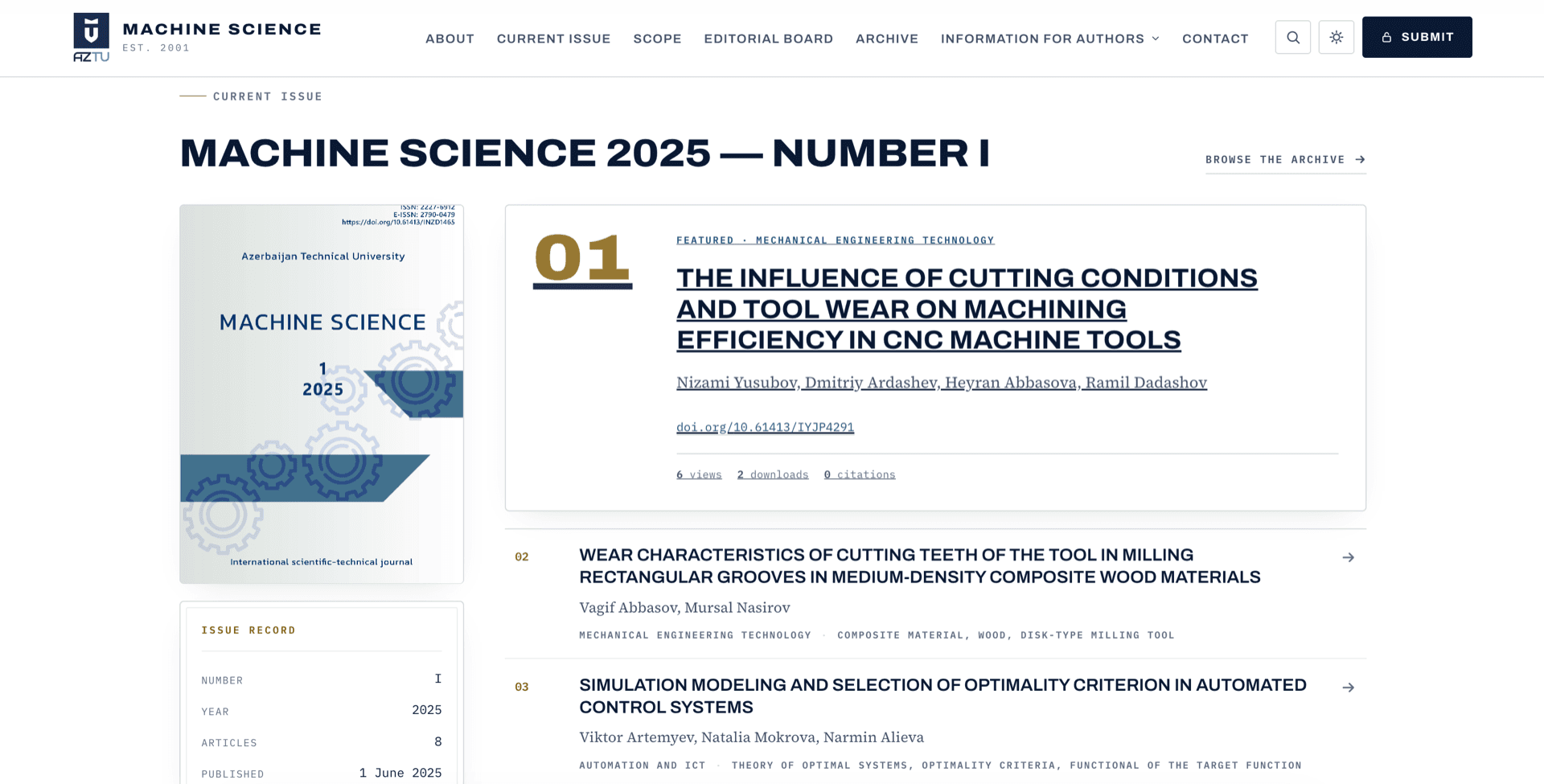
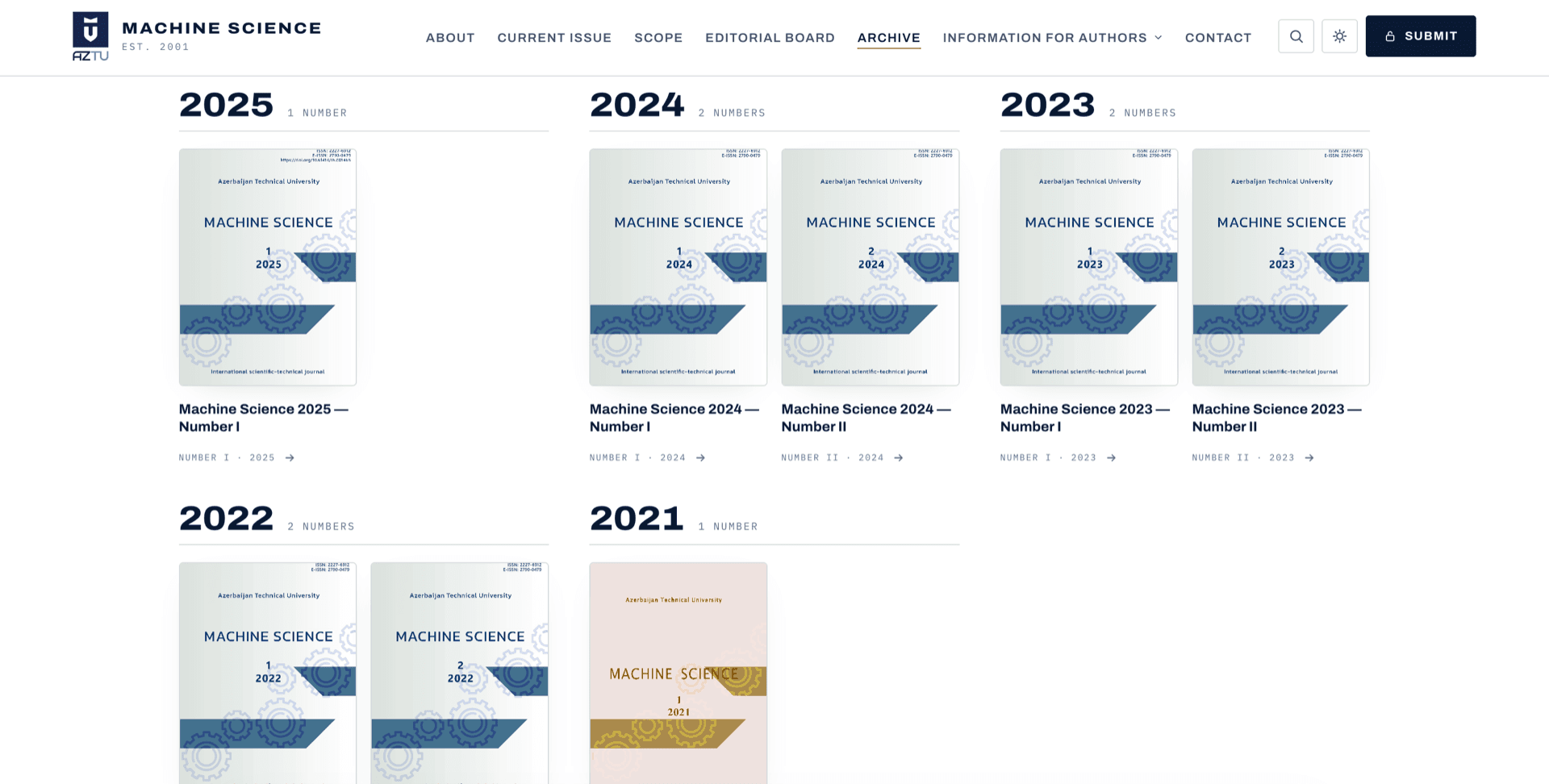
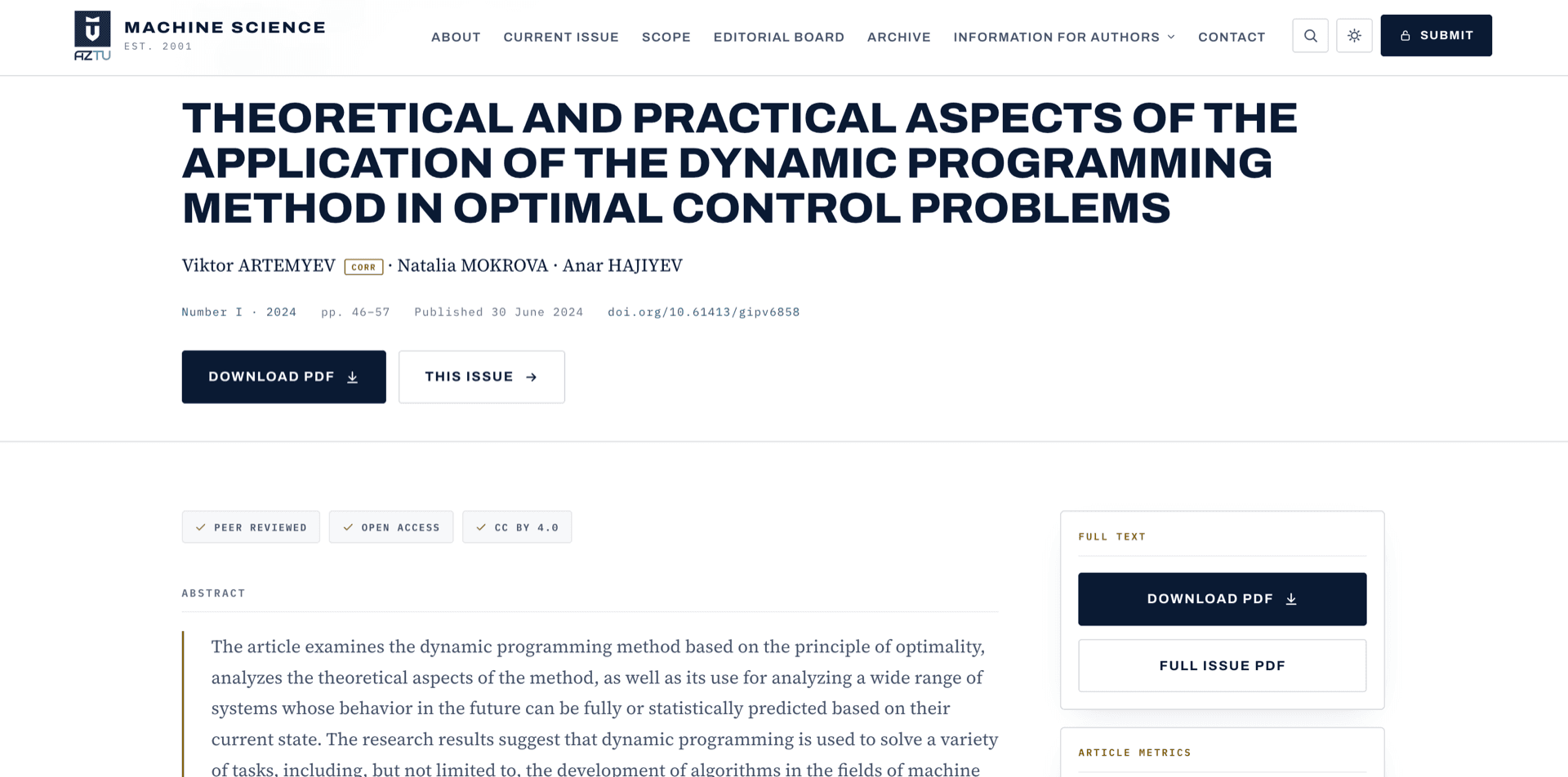
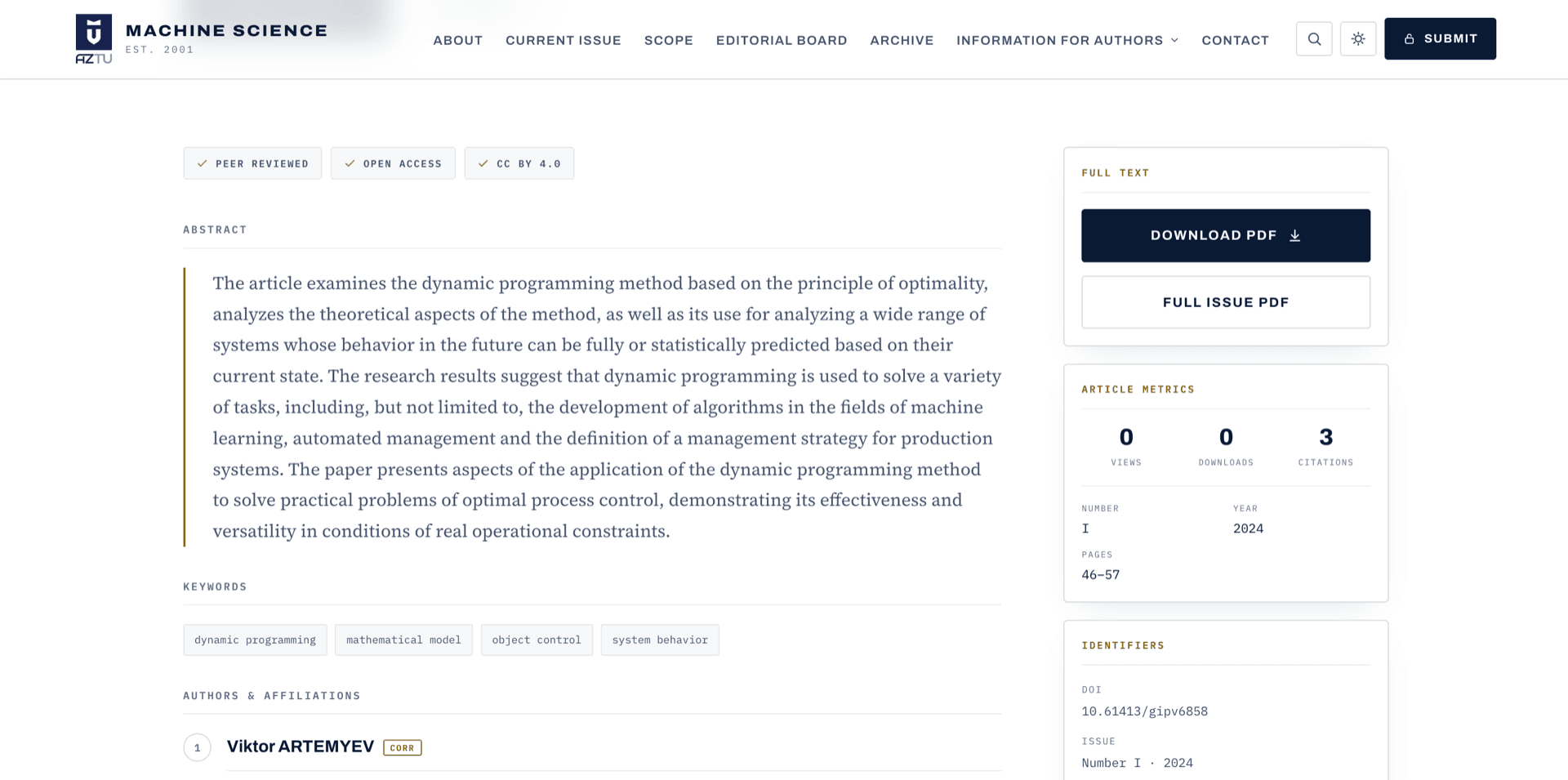
The public side is a full journal reading surface: current issue, year-grouped archive, per-article landing pages with abstracts, keywords, author affiliations, identifiers and article metrics, plus scope, editorial board, contact and author-guidance sections. Everything is free to read and free to publish — no submission, review, or article-processing charges at any stage.
The platform replaced a workflow that lived in inboxes and shared folders. Its point is not just a website: it is the record-keeping layer that makes an academic journal citable, indexable, and auditable — stable article URLs, registered DOIs, machine-readable metadata for indexing services, and an editorial trail behind every published paper.
At a glance
- Journal
- Machine Science — International Scientific & Technical Journal
- Publisher
- Azerbaijan Technical University, Baku
- ISSN
- 2227-6912 (print) · 2790-0479 (online)
- DOI prefix
- 10.61413
- Published since
- 2001
- Frequency
- At least two numbers per year
- Access
- Open access, CC BY 4.0 — free to read and to publish
- Review model
- Double-blind peer review, COPE-aligned ethics
- Indexing
- INSPEC since 2011 · listed by HAC Azerbaijan
- Scope
- Materials Science · Mechanics · Machine Design · Engineering Technology · Automation and ICT · Energy and Environment · Economics and Management
Architecture
The public journal and the editorial portal are separate Next.js App Router surfaces reading one Spring Boot API, so a reviewer-facing bug can never leak into the public reading experience. The public site is statically rendered with incremental revalidation — issue and article pages are prerendered and refreshed on a short stale-while-revalidate window, which is why reads stay fast under indexing crawlers while newly published work appears without a redeploy. Submission, review, decision, and publication are modelled as explicit states on a manuscript rather than boolean flags, so an article's history is reconstructable end to end. DOI registration and issue publication are separated from the editorial decision itself, making publication a deliberate, repeatable action instead of a side effect.
Features
- ▸Author registration and online manuscript submission portal
- ▸Editorial screening and expert (reviewer) assignment
- ▸Double-blind peer review with confidential reviewer decisions
- ▸Editorial decision workflow through to acceptance
- ▸Issue composition — assigning accepted articles to a number, ordering, and page ranges
- ▸DOI registration under the 10.61413 prefix on publication
- ▸Per-article landing pages with abstract, keywords, authors, and affiliations
- ▸Article metrics — views, downloads, and citations
- ▸Year-grouped issue archive with full-issue and per-article PDFs
- ▸Editorial board directory with editor-in-chief, honorary editor, and reviewers
- ▸Full-text search across articles, authors, and keywords
- ▸Author guidance surfaces — manuscript preparation, open-access policy, AI policy
- ▸Light and dark reading themes across every public surface
Engineering challenges
- Keeping double-blind review genuinely blind — reviewer-facing views must strip author identity from both metadata and the manuscript files themselves, and the un-blinding has to happen at exactly one point in the pipeline.
- Modelling the journal's publication unit correctly: an article belongs to a number, a number belongs to a volume year, and page ranges are only fixed at issue composition — so article records have to survive being reordered and repaginated before they go public.
- DOIs are permanent. A DOI can be minted once and never re-pointed casually, so registration had to be an idempotent, replayable step that cannot fire twice or fire before an article has a stable public URL.
- Twenty-five years of back issues had to be represented alongside new submissions without forcing historical papers through a modern review workflow they never went through.
- Serving indexing services and reference managers means the same article has to be correct as an HTML page, as structured metadata, and as a PDF — three renderings of one record that must never drift apart.
- Cache invalidation across a statically rendered public site: publishing an issue has to make the homepage, the archive, the issue page, and every article page consistent within the same beat.
Stack
Screenshots

Questions
About the Machine Science Journal Platform.
- What is the Machine Science journal platform?
- It is the open-access publishing platform behind Machine Science, the international scientific and technical journal of Azerbaijan Technical University. It covers the whole lifecycle of a paper: an author submits a manuscript, the editorial board assigns expert reviewers, the paper goes through double-blind peer review, and accepted work is placed in an issue, given a DOI, and published free of charge at msj.aztu.edu.az.
- How do researchers submit an article to the journal?
- Authors sign in to the author portal and submit the manuscript online with its metadata, author affiliations, and supporting files, rather than emailing an editor. The submission then enters the editorial pipeline, where it is screened and routed to subject-matter experts for review.
- How does the peer review workflow work?
- Reviews are double-blind: reviewers do not see author identities and authors do not see reviewer identities. The editorial board assigns each submission to experts in its subject area, reviewers return confidential assessments against review deadlines, and the editor issues a decision. Accepted articles are then composed into an issue with page ranges before publication.
- How are DOIs assigned to published articles?
- On publication each article is registered a DOI under the journal's 10.61413 prefix and gets a permanent article page carrying its abstract, keywords, author affiliations, identifiers, and downloadable PDF — so the paper stays citable and resolvable independently of the site's navigation.
- What technologies is the platform built with?
- The public journal and the editorial back office are Next.js and TypeScript applications on the App Router, backed by a Spring Boot REST API secured with Spring Security and a PostgreSQL database. The public site is statically rendered with incremental revalidation and served behind Nginx and Cloudflare.
- Is the journal free to read and to publish in?
- Yes. Machine Science is fully open access under CC BY 4.0 with authors keeping copyright, and there is no submission, review, or publication charge at any stage.
Next
Machine Science Journal Platform was built by Firdovsi Rzaev for Azerbaijan Technical University.